
TUI reference
hmz with no command opens the terminal interface. There is no command that opens it too: one way in is one way in.
It is a coding agent's own terminal with a flow underneath instead of one agent — a transcript, a multi-line editor under it, and a status line under that.
The screen
┌──────────────────────────────────────────────────────────────────────┐
│  the transcript: one agent, or all of them, a turn after another     │
│                                                                      │
├──────────────────────────────────────────────────────────────────────┤
│              builder · claude/claude-opus-4-8:high · ● 2 · reading   │  ← what each agent runs
│              reviewer · codex/gpt-5.6-sol:high · ○ 3 · unread        │
│   input 12.4k · output 2.1k · cache_read 1.02M+ · cache_write 48.2k+ │
│                          $1.34 · 91 out/s                            │
│ ❯ type here                                                          │  ← the editor
├──────────────────────────────────────────────────────────────────────┤
│ ·|· builder… (73s · ctrl+c twice to stop)   esc status · tab agent  │  ← the status line
└──────────────────────────────────────────────────────────────────────┘
At the top, the box it opens with: the name drawn large, the version, what humanize is, and three lines on how to begin — what starts a flow, what /flow chooses, and what /providers holds. Nothing about what is set up to run or where it would run — the transcript is a record, so a copy of either up there could only ever be the copy that was true when you opened it. Both are on the lines round the editor, which are redrawn.
The transcript is one agent's, or the one where every agent's work appears together — which is the one it opens on. Which, and how to move between them, is below.
Above the editor, one line per agent the flow drives: the name the flow calls it, then what it runs as cli/model:effort, then the machine its turns land on where that is not this one, what it may do where that is not the ordinary rung, the account it runs as where that is not this machine's own, and finally what it is holding — ● or ○ for whether it is working, how many conversations it has open, reading on the agent whose transcript is on the screen, and unread on one that has said something since you last looked at it. Under them, what the run has cost so far — one figure per kind of token rather than one over the lot of them, then the money and the rate. A + on a kind means some agent of the run drives a CLI that does not report it at all, so that figure is a floor rather than the total; with one agent running nothing is marked. The rate is output tokens a second, over a recent window only, so a flow that has stopped reads as stopped — and the whole readout is worked out again every five seconds and whenever an agent does anything, rather than only when a count lands. The money is per model, since two agents at one model are one bill; it comes from OpenLLMPrices, fetched once as the interface opens and kept under ~/.humanize/prices.json; a model nobody lists shows its tokens with nothing beside them rather than $0.00, and a run mixing a priced model with an unpriced one marks its total $1.34+. See Cost and rate.
The status line, left: what is running, if anything is — whose turn it is and how long it has been going. Between two turns it names the flow and how long the run has been going, since a flow that sleeps off a round, commits, and reads what the last turn wrote has not stopped. A flow that called another flow names both, innermost last: chat ▸ rlar. A flow that has run out of things to do until you say something says waiting for you. With nothing running at all, it names the flow that is set up to run and the directory it would run in, with your home written as ~.
The status line, in front of all of that: which modes the interface is in — afk in the colour of a warning while an agent may not stop and ask you, details while the working is being shown. Each is switched by a line in the transcript that has scrolled away by the time it matters, and neither changes anything else that is drawn, so a mode you cannot see you are in is one you find out about from what did not happen. In front rather than beside, because that is the one part of this row a narrow terminal cannot take away.
The status line, right: the keys that do something right now, and only those. A shortcut listed in a state it does nothing in is worse than one that is not listed at all, and there is nowhere else to look them up. What ctrl+c would do next is what it is called by there, since it is the one key that means something different for having just been pressed. In a terminal too narrow for all of them, the ones at the front go first: those are the keys that mean the same thing whenever they are pressed.
Keys
| Key | What it does |
|---|---|
| enter | Sends what is typed. Over an open offers list, takes what is highlighted instead. |
| shift+enter | Breaks the line, which is what enter would do anywhere else. On a menu it saves what the menu is holding. |
| ctrl+j | The same, both of them, for a terminal that cannot tell shift+enter from enter. |
| esc | Opens /monitor, which is where the run is watched and the flow is drawn. Dismisses the offers list first, if one is open. |
| ctrl+c | Takes back the nearest thing there is to take back: what is half-typed if anything is, the run if not. Twice stops the flow, a third press does not wait for it to unwind, and with nothing running twice leaves. |
| ↑ / ↓ | Walks what was typed here before — but only off the first and last line, so a prompt of several lines is still moved around in. Over an open offers list, moves within the list. |
| tab | Steps to the next agent that is working, and round to the one they all appear on. Over an open offers list, takes the highlighted offer instead. |
| shift+tab | Steps to the one before it. |
shift+enter reaches a program only from a terminal that speaks the keyboard protocol that has a way to say so — Ghostty, kitty, WezTerm, Alacritty. Anywhere else it is a plain carriage return, which is enter, and would send the line: ctrl+j is a line feed and arrives from every terminal there is.
iTerm2 is the one terminal humanize keeps that protocol off in. It loses text composed at an input method while the protocol is on, so a session sitting straight in iTerm2 is never asked for it — and shift+enter does not break the line there. ctrl+j is what does. A tmux in between handles the protocol properly, so iTerm2 under tmux breaks the line on shift+enter like everywhere else.
ctrl+c is asked twice, and means three things. With something half-typed it clears the line, which is what it does in every terminal there is. With nothing typed and a flow running, the first press says press ctrl+c again to stop the flow and the second one stops it: a day's work is behind a key that is also pressed by mistake. A third press does not wait for the flow to unwind — every conversation still open is closed under its turn, which is the backend's process going, and what the flow reads as a turn that failed. With nothing running, two presses leave; /exit is the other way out.
/stop is the same stop, typed, and asks once. The key asks twice because a finger lands on it by mistake; typing a command out and sending it is that deliberation already made. It leaves no half-made gesture behind it either — a press before it and a press after it are not two presses of one — so the press after a /stop is the one that does not wait for the flow to unwind, exactly as it is after the second press, and a first press again once the flow is gone.
esc does not stop anything. It is pressed to dismiss whatever is on the screen everywhere else in this interface, so it is not the key that ends a day's work: it opens /monitor instead, which is where the run is watched and where the flow is drawn.
Focus cannot leave the editor. There is nowhere else for it to go — which is why tab and shift+tab are free to read the agents. While a sheet is up over the interface they are the sheet's, and while the offers list is open tab is its.
Selecting and copying
Drag across the screen with the mouse, and what you dragged across is on your clipboard when you let go. The status line says copied for a moment, which is the only sign there is: a clipboard is written to silently.
| Gesture | What it takes |
|---|---|
| drag | Everything between where you pressed and where you let go, across as many lines as you like. |
| double click | The word under it — everything up to the spaces on either side, so a path or an id comes whole. |
| triple click | The whole line, however many rows of the screen it was drawn over. |
What comes back is what was written, not what was drawn. A line too long for your terminal is drawn over four rows, and copying it gives you the line: no break where the terminal ran out of room, and none of the spaces that padded each row out to the edge. A break in what you copy is a break that was really there.
The box the interface opens with is a picture rather than a line, so dragging across it gives you its rows as they are drawn, borders and all.
The editor selects for itself — dragging in it copies what you dragged across, the same as anywhere else — and so do the lists a sheet offers you to choose from: a click on one of those is still a choice, and only a drag is a selection.
Changing the width of your terminal lets go of whatever was selected. The lines are wrapped again at the width you gave them, so a selection made against the old wrapping is dropped rather than left pointing a line or two off what you dragged across.
How it reaches the clipboard. The interface has the mouse, so your terminal never sees the drag and cannot copy anything itself. What is selected goes out as the escape a terminal takes for its clipboard (OSC 52), which is why it works over ssh: it reaches the clipboard of the machine you are sitting at rather than the one the flow is running on. Most terminals take it; some ask you to turn it on — set-clipboard on in tmux, Allow reporting/clipboard write in VTE-based ones. Holding shift while dragging is your terminal's own selection instead, which every terminal keeps for itself and which copies the screen as drawn, wrapping and all.
Commands
A line beginning with / is a command, a line beginning with $ starts a flow, and any other line is said to the agent. Type / and the list appears under the editor with a line about each.
| Command | Takes | What it does |
|---|---|---|
/flow | [flow] | The menu that is which flow runs and, inside the flow you open, what each of its agents is. With a name or a path, opens already inside that one — and is refused outright while a flow is running, since that name would be choosing one. Without a name it opens on the flows, or inside the agents of the flow that is going. save — the row set below the choices, and shift+enter or ctrl+j from anywhere on the menu — saves the complete setup; esc is one step back, and then the way to save or discard on the way out. |
/flowverses | Where flows come from: what places there are, what one of them holds, and one added, fetched again or taken away. The same menu v opens on the flows; a command as well, because there are no flows to press it on while one is running. Not which flow to run — that is /flow, where the arrows step between the same places. | |
/epics | The runs of this directory, newest first: what each was and how it went. Enter goes into one, which says where it is written down and offers exporting it — trace and all — and carrying it on where its flow says it can be picked up. | |
/resume | Carries the last run here on: that run's own flow, on its own agents, with what it was asked to do, and on what it left behind. The same thing /epics offers of the run you go into, without the list — there is only ever one last run. Where there is nothing to carry on from it says which reason that is. | |
/providers | The accounts an agent may be run as: what there is, and what can happen to one — made, and, on enter, corrected, signed in again, pointed at what it falls back to, or taken away. How often a failed turn is taken again is not here: that is said of a place rather than of an account. | |
/settings | What humanize remembers: two pages, one for what is true of this machine and one for what is remembered about this directory. | |
/monitor | The run, drawn: a box per agent that has worked, marked as it works and saying how long it has been at it, with the handovers between them as the arrows joining them, whatever each started of its own hanging under it, and the board below. Enter reads an agent or changes a line. esc opens it. | |
/btw | <question> | Asks a side question about the running flow from a read-only snapshot of its progress. It runs in a separate session and never steers the flow. |
/details | [on|off] | Shows or hides everything a turn did on the way to its answer: tool calls, thinking, and whatever a backend printed on its way past. One question — how much of the working to show — so one switch. Off to begin with. |
/afk | [on|off] | Whether an agent may stop and ask you something. See below. |
/fallback | Where a turn goes when what was taking it cannot: an agent that has nowhere left to run, and an account that has gone down. See below. | |
/clear | Clears the screen, and nothing else: the transcript being read, not the others, and nothing that is running. | |
/stop | Stops the flow — the whole flow, not just the turn — which is what ctrl+c twice does. It is not asked twice: the key asks because a finger lands on it by mistake, and nothing is typed by mistake, so writing it out and sending it is the deliberation the second press stands in for. With nothing running it says so, which the key never does; a flow already told to stop and not yet gone is said to be stopping rather than told again, and the third press is what is left for that one. | |
/exit | Leaves; a flow that is running can be left running. With one going it asks first what is to become of it: stop it and leave, or let go of this terminal and leave it running — the run carries on where nothing is reading it, and hmz in this directory opens it again from the top. That second answer is offered only where something outside this terminal is holding the run; where nothing is, closing the terminal is what closes the run, so the answer offered instead is staying here. With nothing running it is a window being closed, and asks nothing. |
/details and /afk flip when given nothing, and take on or off when you want to say which.
hmz internal anchor is deliberately not here. It is not a thing to do to a flow that is running, and a command that only ever means one thing is a command line.
Starting a flow outright
$<flow> <prompt> is the flow said outright rather than chosen from a menu and then talked to. $ralph_loop fix the failing test means run ralph_loop on that. Two answers stand between you and a run — which flow, and what to do — and one of them is the same answer every morning.
$ralph_loop fix the failing testWhat happens next depends on whether this directory has run that flow before:
| Set up here already | It runs, now. No menu: a menu of answers already given is not a menu to answer again. |
| Never set up here | /flow opens inside that flow, on what drives it. The line you typed is held; the flow runs on it the moment the menu is saved. Walk out without saving and nothing starts, and it says so. |
| No such flow | A line to correct, the way /nosuchcommand is. The interface stays up. |
Set up here means a remembered agent for every place the flow declares now — under the name the flow calls that place, and in the flow's own order — and settings the flow still accepts. A flow that has grown, lost or renamed an agent since is one you are asked about again, rather than one whose new reviewer quietly inherits the builder's model. So are settings that no longer read back through the model the flow declares now: nothing can guess what an answer that no longer fits was meant to say. A flow you never set any settings for is not one of those — it takes its own defaults, exactly as hmz exec does with no -c.
$ takes a name, not a path: a path holds the slashes, dots and spaces prose does, and one taken here would swallow the line after it. /flow ./flows/mine is where a flow of your own by path is reached.
$ alone chooses nothing — a line whose $ is not followed by something shaped like a flow name, and that by whitespace or the end of the line, reaches the conversation like any other line. $ ls -la, $5 says otherwise, $(pwd) and a bare $ are all said, not started. Whitespace rather than a space, so a long prompt broken under the name with shift+enter is the prompt rather than part of it. A $ naming a flow and saying nothing after it — $ralph_loop — chooses that flow and stops there: there is nothing to start it on.
Two things it will not do. It is refused while a flow is running, and leaves that run exactly as it was: it is choosing a flow, and there are no flows to choose from while one runs. And it is not read as a flow while an agent is waiting on an answer — the next line you type is that answer, whatever it begins with.
Leaving, and letting go
Closing the interface and stopping the run are two things. The run is held in a process of its own, so a flow that is running goes on running where nothing is reading it — which is why /exit asks rather than assumes, and why letting go of the terminal is one of the answers rather than a command of its own:
A flow is running.

❯ 1. stop it, then leave
  2. leave it running             `hmz` opens it again

enter choose · esc stay
Where the run is not being held — output going to a file, or a machine whose HUMANIZE_DAEMON says not to hold one — the second answer is staying here instead: an answer that cannot be carried out is not one to offer.
ctrl+c twice is still what stops a flow, and is not what lets go of a terminal. ctrl+q puts the same question /exit does, rather than leaving outright: a key bound to leaving is a way round the one thing this asks about.
Reading one agent
A flow drives several agents, and each of them holds as many conversations as it likes — a Ralph loop opens one a turn, a fan-out holds one per worktree. All of them written down the same screen with no way of reading any one back is none of them readable, so there is a transcript per agent, and one more where every agent's work appears together. That last one is what the interface opens on: before you have any reason to single an agent out, what you are watching is the flow.
tab and shift+tab step round it and whichever agents are working, wrapping at either end. With ten agents going, what you are stepping between is the ones thinking right now, not the ones that have stopped. An agent between its turns is still read once you are on it — what you are reading is left where it is until you press one of these — but it is not stepped onto. Every agent that has worked can still be read from /monitor, which draws the whole flow: that is where the one that has stopped, or has not started, is picked out by name.
Every conversation of one agent is that agent's one transcript, running on down it. A Ralph loop opens one a turn, and nothing is redrawn when it does — the screen would otherwise be wiped every turn, taking with it the turn you were reading, the line you typed and whatever went wrong. Which conversation a turn is in is said where the turn begins, for an agent holding more than one:
● claude#a1b2 is working · conversation 3 of 3Stepping onto another agent draws that agent's transcript from the top, under a line saying which is being read. What one agent has done is that agent's; a screen that only ever appended would be every agent's lines shuffled into one another. Only /clear clears, and it clears the one you are reading rather than reaching into ones you were not looking at.
On the transcript they all appear on, a line says which agent each part is from as that changes — once, rather than a name against every line:
── claude#a1b2

● claude#a1b2 is working

● Ready. The tests pass.
The line above the prompt says which agents are working: ● for one with a turn open, ○ for one that has stopped. It is the first thing to look for with several going at once, and the only thing on that line that changes by itself:
   builder · claude/claude-opus-5:max · ● 2 · reading
   reviewer · codex/gpt-5.6-sol:high · ○ 1 · unread
reading marks the agent whose transcript is on the screen, and unread one that has said something since you last looked at it — so a flow of ten agents is not nine nobody knows to look at. Nothing is marked unread while you are reading all of them at once: what an agent said went onto that screen too, and you have just read it there.
A flow that talks to you is talking to you here, so the person is not one of the agents these keys move between. With no flow running there is nothing working, and both keys leave you on the transcript they all appear on.
A typed line goes to the agent you are reading — of its conversations, the one with a turn open. Where you are reading all of them at once there is no one agent you can have meant, so it goes to whichever has a turn open, which is the one the screen is showing anyway.
What is kept is bounded, a flow being a thing that runs for days: the last eight conversations, and the last two thousand lines of each. Older lines and older conversations are gone from the screen, not from the trace — that is what a trace is for.
Watching the run
/monitor draws the run, and esc is what opens it. It is read rather than answered, so it is not refused while a flow runs, and it is redrawn while it is open — what it is about moves without anybody touching it.
The diagram is the sheet. It takes the height the terminal has, and what is written under it is only what a picture cannot say. The shape of a flow is not written down anywhere: a flow is a Python file that may branch any way it likes, so what it did is read off the turns going past — and drawn as a box per agent, in the order the flow takes them, with the handovers between neighbours as the arrows joining them:
   ▣ every agent · 1 of 2 working · 17 turns · 7m11s

   ┌────────────────────────────────────────────────────────┐
   │ ● builder · claude#a1b2                            43s │
   │ claude/claude-opus-5:high · 12 turns                   │
   └────────────────────────────────────────────────────────┘
     ├╴◆ Task read the tests
     └╴◇ Task find the flaky one
   │   ↓ 6 · ↑ 5
   ┌────────────────────────────────────────────────────────┐
 ❯ │ ○ reviewer · codex#c3d4                     idle 1m04s │
   │ codex/gpt-5.6-sol:high · 5 turns                unread │
   └────────────────────────────────────────────────────────┘

   Board · what you and the flow both write on
   ◈ todo                      write the parser
   ◈ doing                     two of five · flow's

   Flow:             chat
   Also:             builder → reporter · ×2
   Tokens:           claude-opus-5                48.2k    $1.34  91 out/s
                     some-local-model             9.1k            12 out/s
   Kinds:            input                         1.2k
                     output                          980
                     cache_read                   46.0k
                     cache_write                   9.1k
Each box says what its agent is on the left and what it is doing on the right. What it runs and how many turns it has taken stand still; the right-hand column moves. ● is an agent with a turn open and ○ one that has stopped, and beside them is how long the open turn has been open — or, for one that has stopped, how long it has been since its last turn ended, so the agent that has been quiet four minutes is the one that stands out. reading marks the transcript on the screen behind the sheet and unread one that has said something since you last looked at it.
The arrows carry the handovers, with how often each way went, and the one the flow took most recently is drawn lit: with six boxes on the page, where the run just went is the first thing you look for. A handover between two agents the boxes did not put next to each other is said under the diagram as Also rather than drawn — a line crossing the page from the first box to the fourth is a line nothing in a terminal draws readably.
Tokens is one row per model, biggest spender first, with what it has cost in tokens, what that came to in money, and the rate in output tokens a second. The blank in the money column is a model nobody prices — never a bill of $0.00, which would be a claim about what was spent.
Kinds is one row per kind of token, over every model: a bill is made of the kinds whichever model bought them, so this is the run's rather than any one model's. A figure marked + is a floor — some agent here drives a CLI that does not report that kind, or something was counted without its kind being said — with a line under the block saying so. See Cost and rate.
A box appears as its agent takes its first turn, and not before. A flow may declare ten agents and reach three of them, and seven boxes that have never done anything are seven rows saying nothing: the diagram is what the run is doing rather than a list of what was set up. Each stays for the rest of the run once it is there. Before any of them has worked, the sheet says so, and lists the agents that are set up — which is the one thing it says about them that the boxes are not there yet to carry.
An agent one of them started of its own hangs off its box, without a box of its own: ◆ for one still going, ◇ for one that has come back. It is a thing the agent above it is doing rather than an agent of the flow — nobody chose what it runs, nothing can be said to it and it has no transcript — so it is not a row to open, and a box round it would say otherwise. Only the backends that say draw one. A fleet too long to draw is cut, with a line saying how many were left off.
The board is under the diagram, for a flow that talks to you: the named lines you and the flow both write on, and neither waits at. a puts one up — a name, then what it says — enter changes the one under the cursor, and d twice takes it off — the one taking-away still on a key, because enter on a line opens the words of that line rather than a menu with a row to spare, and it lands the moment it is pressed. A line the flow keeps to itself says so instead of opening an editor. See The mission board.
Enter or a click on a box reads that agent — whether or not it is working. tab is held to the ones thinking, so this is the one place an agent that has stopped is reached. The box under the cursor is drawn in the marker colour rather than highlighted, ❯ beside its name; the first row is the transcript every agent's work appears on, which is the way back to watching the flow rather than one agent of it.
The agents of the last run are still drawn once it is over, and every clock on the sheet stops where the run stopped. Their transcripts are still on the screen and still worth reading back, a run that has just ended is usually the one you want to look at, and a diagram still counting would say the flow was still doing something.
Talking to a running flow
The editor means both things at once. A line typed while a turn is running is put into that turn rather than starting another, so the agent takes it into account instead of being restarted with it. If no turn is open, it is held for the next one — a line to a running flow is never dropped.
A line that is being held is pinned onto the editor rather than written into the transcript, dimmed, behind the same ❯. It shares the block that sits on the prompt with what the run is running as, and the two are read from the bottom up — the last line typed and the running total end on the same row:
                                           assistant · claude-opus-5:high
❯ and fix the tests too            input 11.2k · output 1.1k · cache_read 0
❯ then push                                           $0.31 · 84 out/s
────────────────────────────────────────────────────────────────────────
❯ █
It has not been said to anybody yet, and the transcript is what happened. The moment something takes it — the next turn, or a flow waiting to be told what to do — it comes off the pin and into the transcript, in front of the turn that took it.
Handed to a backend is not the same as taken. A line put into a turn that is already running stays pinned too, now against the agent it went to:
❯ and fix the tests too · with claude#3a15It comes off only when that agent's own turn says the words are in front of it — each backend says so in its own way, and humanize waits for whichever it is. A turn that ends without ever saying it had the line puts it back into the transcript as never sent, so a line typed at an agent that was not listening is never quietly counted as said.
Lines go one at a time, in the order you typed them. Everything typed joins one queue and leaves it a line at a time: the next one goes only once the turn has said it has the one before it, and a turn takes one waiting line rather than the whole queue. Three hi in a row are three things said and come back as three answers — handing a backend two at once has it run them together and answer once.
The pin is held to a few rows: a line longer than the screen is cut with an ellipsis rather than wrapped, and what will not fit is counted instead — … 3 more waiting, or … 6 more lines for one message too long to show whole. Only what is drawn is cut; the whole of what you typed is what goes. A flow that ends, however it ends, drops whatever is still pinned into the transcript and says it was never sent.
A line reaches the agent you are reading — of its conversations, the one with a turn open. Not whichever agent happens to be working: a flow drives several, and a line said to the one that is not on the screen is a line said to somebody else. Reading all of them at once there is no one agent you can have meant, so it goes to whichever has a turn open. A conversation between turns would answer it on its own, outside the flow, so it waits for the turn that starts next instead.
How far "into the turn" it gets depends on the backend:
| Backend | What a mid-turn line does |
|---|---|
| Claude Code | Answered within the same turn. The turn is over once the agent has answered everything it was told, not when it first stops. |
| Codex | A steer on the turn its app server is running. |
| Kimi Code | Queued, then steered into the turn already running. |
| pi | A steer on the run it is making, taken into it rather than answered after it. |
| opencode, mimocode | Nothing: a run per turn has ended by the time there is anything to say to it. |
| ZCode | Nothing: its app server refuses a second prompt while one is running, and what its own terminal steers with is a channel that terminal holds. |
An anchored Claude ends its process with each turn so that its work reaches the target before the turn says it landed — so it hears you between turns rather than during one. An anchored Codex keeps one app server for the life of the agent and can be steered throughout, at the cost of that same guarantee.
Questions, and being away
An agent may stop mid-turn to ask you something. The question and whatever it offered are shown, and the next line you type is the answer rather than a word put into the turn — the status line says enter answer while that is so.
/afk says you are not there. An agent that wants to ask is then told nobody answered and carries on, rather than waiting on a reply that is not coming. Asking starts allowed: an agent that really needs a person gets one unless it has been said that none is there. While it is on, the status line says afk in front of everything else on it: the one sign that a turn went unanswered must not be a flow that finished early.
A question still up when the flow ends or is stopped ends with it, so stopping a flow is never blocked on one.
Completion
Nothing is chosen from a dialog. A half-typed line is offered what it could be finished with, in a list under the editor:
/offers the commands, each with a line about what it does and what it takes after its name./flowoffers the flows there are — the ones humanize ships, the ones every flowverse fetched here holds, and your ownlocal/anduser/ones under.humanize/flowshere or in your home directory.$offers the same list, under the sigil that starts one, and only while the word after it is the one being typed: everything past that word is the prompt, which is prose.
A word already written out in full is offered nothing, whether it is a command or a flow. Enter over an open list takes what is under the cursor rather than sending the line, so /flow — with /flowverses beside it — and $rlar — with $rlar2 beside it — would otherwise be lines nobody could send.
An offer is the whole of what the word becomes, so taking one replaces what was typed rather than being appended to it. What is offered is reconsidered when the cursor moves as well as when the text does: an offer made at the end of a line does not still stand once the cursor is back in the middle of it.
A flow anywhere else is a path, and a path is typed. Looking for one would mean reading every Python file below here to see which declare a flow — a guess, and far too slow to make between keystrokes.
History
Everything said goes down: the task that started a flow and the words put into one already running alike. Both are things you wrote, and either may be worth writing again.
↑ and ↓ walk it. What is walked is what was typed in this directory — and, where nothing has been typed here yet, everything ever typed anywhere, so a fresh project still has something to walk back through. Which of the two it is is settled when the interface starts, so a history cannot change under you mid-session.
The menus, and when what they hold lands
/flow, /providers, /fallback and /settings are menus rather than walks. What is true of all of them:
- No key is a chord, except the one that saves. A menu asks one thing and its keys are its own, so nothing here needs a modifier held down — but saving has no bare key left to be, enter opening the row under the cursor and every letter being taken. So it is shift+enter, and ctrl+j beside it: a terminal reports shift+enter as itself only where it speaks a keyboard protocol that can say so, and sends a plain carriage return where it cannot — which is enter, and would take whatever the cursor was on. Both are said at the bottom of every menu that holds anything, and neither is the only way through: saving is a row as well.
- Typing does not search. Every letter is a key, so a search is asked for with s and left with esc, which clears what was typed. While one is running the letters go into it, and the row of keys says so.
- The keys are said at the bottom, and nowhere else. The line above a menu says what the menu is; the row under it says what the keys do. A key named in both is a key learned twice and a line of width spent saying nothing.
- Nothing lands until you save. Every menu that holds changes has a
saverow set below the choices — below, and out of their numbering, because it is what to do with the menu rather than one more thing to pick out of it — and takes the chord above from anywhere on it. Esc remains available: it asks in a box in the middle of the screen, over the menu rather than instead of it, whether to save or discard. Esc on the box is the way back to the menu. A menu you only looked at asks nothing. - A list you can add to has an
addrow, set below the choices the waysaveis, as well as the letter that does it. A key advertised only at the bottom of the screen is a key you have to read the bottom of the screen to find. - A row the arrows adjust is cycled by space too, and says so:
↔on the row means this one changes where it stands, and▸means this one opens something. Space takes the next value and comes round to the first at the end of the range, on every menu alike.
/epics and /flowverses are lists of the same kind, and all of that holds of them but the saving: neither holds a draft of anything, so what is asked for there happens as it is asked for, there is no save row, and esc asks nothing on the way out.
Pages are parallel — two views of one question, either of which you might read first. A menu of several shows their titles across the top, and tab / shift+tab turn between them; a page that cannot be opened right now is still a title, struck through. A menu of one page draws no strip at all, one title being nowhere to turn to.
What you reach by picking something is not a page. Enter opens it and esc comes back, which is one step rather than the way out of the menu — the same two keys they are everywhere else here. A tab between two views of one question is orientation; a tab between a list and the thing you picked out of it hides the fact that you picked anything, so it is not offered. A page made of several lists names them where the titles go, and ← / → step between those.
Choosing a flow
/flow puts up the flows of one place at a time, with ← and → stepping between the places: every flowverse — official, which is chat from the package plus whatever else has been fetched or added, and last local, this project's flows under .humanize/flows, and user, yours under ~/.humanize/flows, each where there are any. The strip above the list is the places, with the one being read marked; the list is that place's flows and nothing else.
  Flow

  Which flow drives the agents; what it is to do is the next thing you say. A flow anywhere
  else is a path you type.

  official · local · user   ←/→ switch

❯ 1. chat                    Chat — one agent, one session, and every line typed between…
  2. continue_loop           Continue loop (flowbench: continue_loop) — send the task once,…
  3. fixed_juice_ralph       Fixed-juice ralph (flowbench: fixed_juice_ralph) — a ralph loop…

enter open · f copy here · v flowverses · shift+enter/ctrl+j save · esc close · s search| Key | |
|---|---|
| enter | Open that flow: what drives it, which is the next thing to answer. |
← → | Read the place before or after this one, wrapping round. |
f | Copy the flow under the cursor into .humanize/flows/, whole — what it imports and the skills it brings — to change. Your own are looked in first, so from then on that name means your copy. |
v | Where flows come from: the places themselves, and what can happen to one. |
The list opens on the place the flow in force came from. A flowverse that has never been fetched is fetched as the menu opens — which in practice is official, the one every flow that is not in the package is in — in the background, once per opening however it goes, and without moving what you are reading: this is the place nobody fetched being fetched because its flows are wanted, not somebody asking to be taken to it. It runs off the interface's own loop — the menu keeps drawing while it clones — and what became of it is said under the list rather than thrown at you. A place with nothing in it says so where its flows would be, and one that has never been fetched says which key opens the menu that fetches it: adding a place, fetching one again and taking one away are v.
Every start fetches every flowverse, in the background as the interface opens, one at a time and without a word about it — whether or not it has ever been fetched here. A flowverse is a copy of somebody else's repository, and one only ever fetched again when somebody thinks to press a key is one that is months behind by the time anybody notices; one that has never been fetched is the one whose flows you cannot run at all. There is already a list of flows to show, so nothing waits on it and nothing is said about how it went — a machine with no network is no slower and no noisier for it. It leaves alone a clone you have written into, since a fetch resets one to what the repository says now, and it stops at a flow that starts running, for the same reason read the other way round.
A fetch that lands makes whatever is drawn read the flows again. A menu that lists flows reads them once and holds what it read, since reading a flow means running it — so a download landing underneath would leave the list from before it, and a flow that arrived in the fetch would be one the menu does not offer while a flow whose file changed would be one it will not load. Both used to come right only on a restart, which was the fetch working and nothing showing it.
Enter on a flow opens it: what that flow was last set up with here is read back, what the flow itself takes is asked where it takes anything, and what drives it is what you land in — which is the next thing to answer. Esc comes back to the flows, one step, and esc again leaves the menu. The save row inside a flow — set below its agents, and reachable on shift+enter or ctrl+j from either half of the menu — validates every agent and applies the flow and all its agents together.
There are no flows to choose from while one is running — a flow is chosen in order to be started, and there is one going. So /flow opens inside the agents of the flow that is going, and esc there leaves: an agent thinking too little, on the wrong account or allowed too much is something you find out halfway through a run. What you save then reaches the agents that are running, each of them from its next turn on. A CLI you changed is the one thing that cannot be swapped under a flow already holding that agent, and says so.
This menu is the only way in that is typed. A machine being set up or a script reaches the same places through Hmz().verses — add, fetch, remove and holds, which are these keys under another name.
s starts a search, and what is typed into it narrows by name. What each flow says about itself is beside its name, and is not searched: a subsequence of a sentence matches nearly everything. A search narrows the strip to the places it found something in and steps to one of them, so what you type finds a flow without your having to remember which flowverse it was in.
Where flows come from
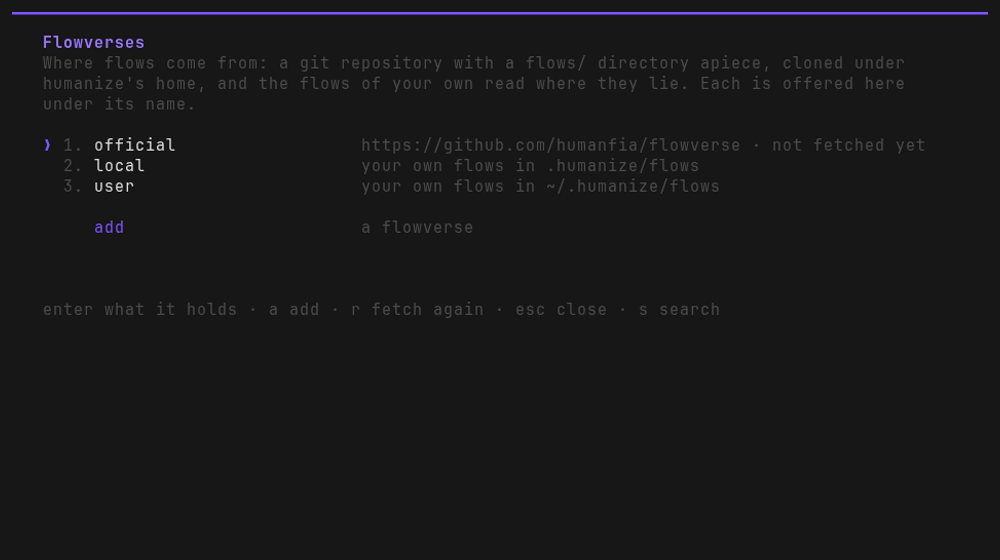
v in /flow, and /flowverses, open the places themselves — a git repository with a flows/ directory apiece, cloned under humanize's home, and the flows of your own read where they lie. Each is offered under the name it is listed under. A place that has never been fetched is listed all the same, with its URL and not fetched yet beside it: what there is to run is not the same question as what has been downloaded.
| Key | |
|---|---|
| enter | What that flowverse holds: one row per flow, with the line it says about itself, and past them the row that takes the flowverse away. Reading the flows means importing them, so it is asked of the one you opened rather than of all of them at once. |
| a | Add one: a URL or an owner/repo, and a name to keep it under. The add row below the list does the same. |
| r | Fetch the one under the cursor again, or for the first time. official already holds chat, which came with humanize, and fetches the rest from its GitHub URL; local and user are directories of your own and say there is nothing to fetch. |
Taking one away is inside what it holds, rather than a key on the list. What a flowverse is, is what is in it, so the decision to be rid of one is made where that has just been read — and the row is past the end of the flows, out of their numbering, because it is about the place rather than about anything in it. official, local and user do not offer it at all, and the sheet says why where it would have been.
Its own menu rather than two more keys on the flows, because they are about something else: adding a repository and fetching one again are done to the list of places, while the list they would be keys of is asking which flow to run — and a sheet that asks one question with keys about another is a sheet asking two. Its own menu rather than a deeper view of /flow for a second reason: that menu holds everything until you save it, and each of these runs git as you ask for it.
/flowverses stays a command as well as a key, because the key belongs to the flows and there are none to choose from while a flow is running. Either way in is the same sheet.
v is refused while /flow is still fetching the place it opened on, and says so under the list: two clones of one place land in one directory, and the one that loses takes the other's work with it.
What happens here happens as it is asked for rather than when the menu is saved: each of these runs git, and something that has already been cloned is not a draft. A clone runs off the interface's own loop, so the menu keeps drawing while it fetches, and what came of it is said under the list and again in the transcript on the way out. Nothing here is refused while a flow is running: a place fetched now is one the next run may reach for, and none of it touches the flow that is going.
The flows kept the two keys that are about flows rather than about places: ← and →, which step between these same places because that is which list of flows is being read, and f, which copies the flow under the cursor into this project.
Typing /flow and pressing enter still sends /flow. A command that has been written out whole is offered nothing at all, so /flowverses is never left standing under the cursor with enter meaning it.
What each agent is
Opening a flow in /flow lists what it drives, by the name the flow calls each, and enter opens one. Everything that agent is is a row of one sheet:
  Set up builder

  What this one agent is: the CLI that takes its turns, the account they run as, and the
  model at an effort.

  ❯ 1. cli          claude ▸                   which coding agent takes its turns
    2. provider     as local ▸                 the account those turns run as
    3. model        claude-opus-5 ▸            which of that CLI's models it runs
    4. effort       high ↔                     how hard it thinks
    5. where        this machine ▸             the machine its work lands on

       save                                    this agent

  enter open · shift+enter/ctrl+j save · esc close
An agent is a CLI, an account, a model and an effort, and nothing else. What it may do, which goals it may reach for and whether it may search the web are the flow's — they are declared where the flow declares the agent — and the skills it carries are its CLI's, installed and switched off where that CLI keeps them. None of them is a row here, because a row offering to set one would be a second answer to a question already settled.
What the flow said and this sheet does not ask comes back off it unchanged: setting the effort does not reset anything the sheet never showed you.
The rows are in the order of what depends on what. The CLI settles which accounts there are and which models that CLI will name; the account settles which of them it may name. Changing the CLI lets go of the model, which belonged to the CLI before it.
The arrows step a row that is a rung in an order — the effort, and swarm mode for a model that has one — and space takes the next one, round to the first again at the end of the range. Those rows wear ↔; the ones that open a sheet of their own wear ▸. where is a row only for an agent the flow says may be pointed at a machine; for one the flow put in a container it is read rather than opened, and for one that works here it is not there at all.
save — the row below them, and shift+enter or ctrl+j from anywhere on the sheet — accepts this agent and returns straight to the flow's agents. It changes only the flow draft; the complete setup is written down when save is chosen there. Esc off the agent sheet remains a fallback: it asks whether to accept or discard changes.
Which CLI, and which account
Two rows, in that order, because an account is one backend's — what signs in to Claude Code is not what signs in to codex. The CLIs are the ones installed here, less any the flow ruled out by needing a moment or a goal feature that backend has not got — plus any supported backend that is only a pip install away, which is listed so that it can be found rather than looked for, and says so on its row:
   Select the account its turns run as

   ❯ 1. as local                  signed in as you signed it in
     2. deepseek                  gateway · ANTHROPIC_AUTH_TOKEN, ANTHROPIC_BASE_URL
     3. work                      login

        add                       an account

   a add · enter choose · esc back · s search
as local — always the first row — is what every agent ran as before there were any accounts: the CLI signed in the way you signed it in, with nothing redirected.
a, and the add row below the list, make one without leaving the question. This is the moment you find out that the account you want is not there, so it is the moment to be offered it: it asks how to sign in and what that way needs — the same walk /providers runs, minus the question this row has already answered — hands the terminal to the CLI's own login where the way has one, and comes back with the new account chosen. A CLI with no accounts yet says claude has no accounts here yet under the list, with the add row under that.
An agent given an account that has since been taken away is a red line when the flow is started, before any turn has run — never a traceback half an hour in.
What each agent runs
The model row: which of that CLI's models, and under it the effort, stepped where it stands.
   Select what claude runs

   Which model of claude takes this one's turns, and how hard it may be asked to think. These
   are what it last said it runs as this account.

     1. claude-opus-5           max, high
   ❯ 2. claude-sonnet-5         max, high

   r ask it again · enter choose · esc back · s search
The list is what the account chosen above it may name, not a list written into humanize: a CLI ships a model without asking anybody, and which of them you may name depends on the account. Where that account points its CLI at an endpoint, the endpoint is what was asked — a CLI handed a base URL can only answer with the models it shipped with, which is not what your key will run. It is asked the first time the interface opens, and again whenever an account is made. r asks it again from here, which is where you find out that the model you came for is not in the list. An account that has never been asked says so where the list would be; one where nothing would answer says why, under the list, and leaves the sheet up.
Choosing a model you were not already on starts the effort at the hardest that model takes — the one to reach for. Choosing the one you are on leaves the effort where you had it.
Where each agent works
The where row, and only for an agent whose place the flow declared Remote. Where an agent works is the flow's to say rather than a setting anybody may reach for — a flow written to read this project cannot have one of its agents reading somebody else's — so:
| What the flow declared | What you are asked |
|---|---|
Annotated[Agent, Remote] | a where row: which machine its work lands on |
Annotated[Agent, Isolated("python:3.12")] | nothing; the flow named the image, and the row reads in a container of python:3.12 |
Agent | nothing; it works here, and there is no row |
The sheet lists what this machine can see — each container that is running, each host with an entry in your ~/.ssh/config — and anything else is a target you type after s:
| Typed | Where the work goes |
|---|---|
| (nothing) | this machine |
docker://<container> | a container that is already running |
ssh://<host> | a host you can reach |
tcp://<host>:<port> | a coganchor target listening there |
An agent the flow says may move but that nobody has pointed anywhere still works here: the row is offered, not forced. The agent itself runs here whatever you choose — its credentials, its state directory and its link to its model provider stay put. What moves is the project it reads and the commands it runs. See Remote execution.
Two agents of one flow may work on two machines, since it is a setting of the agent. A target that cannot be read, and an agent pointed somewhere by a flow that does not say it may be, are both red lines when the flow is started, before any turn has run.
What each agent carries
Nothing here. The skills an agent carries are its CLI's own, found where that CLI looks and switched off where that CLI switches one off, and there is nowhere in the interface to change them: what a person installed is not something a flow is entitled to rewrite, and a list you could adjust here while the CLI's own list said otherwise would be two answers to one question.
What a run adds to them is the skills the flow brings, mounted onto every session its agents open and taken away again after.
The runs that have already happened
/epics is every run of a flow in this directory, newest first. A run writes itself down as it happens — which flow, on what, by which agents, and every session each of them opened — and this is what reads it back:
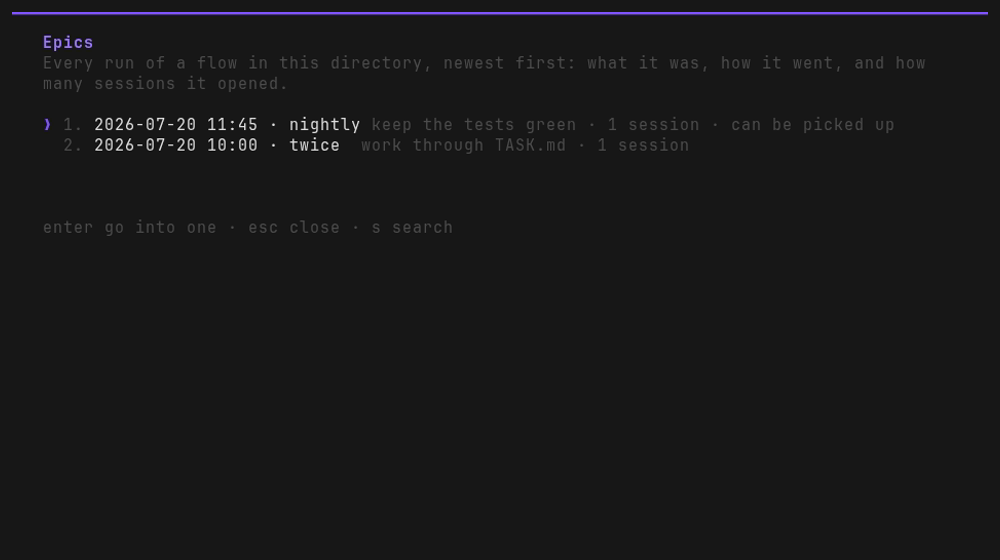
A row is when the run began and the flow that ran; beside it, what that flow was asked to do, how many sessions it opened, and can be picked up for a run whose flow said it was resumable. How it went is there only where it went some way other than finishing — stopped, failed, or left unfinished by a machine that went away under it — since a list of runs is mostly runs that finished, and a column saying so of nearly all of them is a column taking the room the others need. Newest first, because what somebody who opens this came to look at is the run that has just happened. s searches the flow, what it was asked to do, and the name the run is written under.
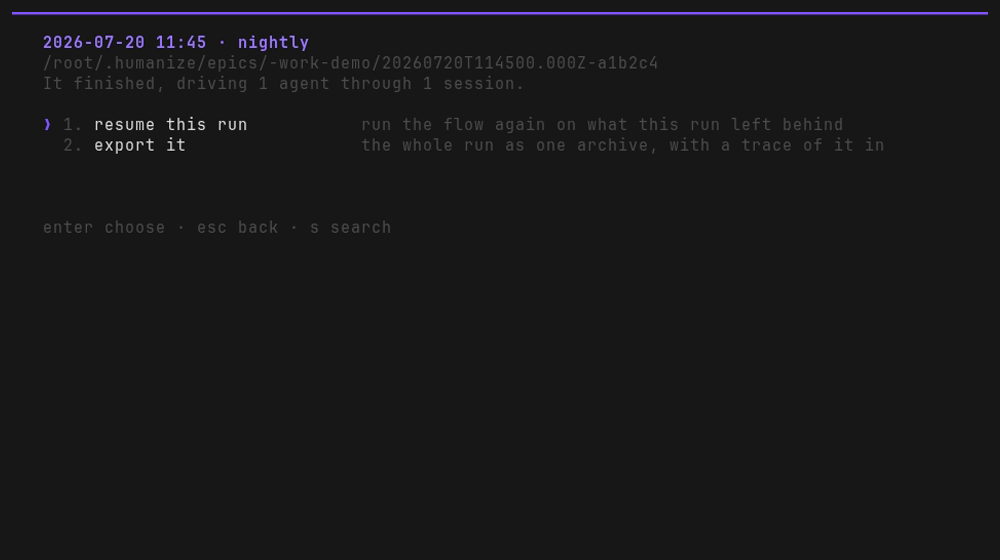
The list is read rather than chosen from, so enter goes into the run under the cursor. What opens says where that run is written down — sessions and all, which is what anybody reading one back opens — and under it what there is to do with it:
| Row | What it does |
|---|---|
| resume this run | Runs that run's own flow again, on what that run left behind — which a flow that says it can be picked up is handed. It is /resume with the run already named, and a run that cannot be carried on is turned down here in the same words. |
| export it | Packages that run up as one archive to send to somebody else — its own records, every session log the backends wrote for it as their contents rather than as the links the run keeps, a manifest, and a trace of the run gathered on the way in. There is no transcript in this one: what is on your screen is not that run. Where it landed and how big it came out are said under the list, and again in the transcript. See Exporting a run. |
Exporting gathers the trace. They were two rows, and one of them wrote a file into the run that the other packed anyway. So the archive holds traces/export.trace.json of that run's sessions — and the programs it ran, for a profiled run — which is what makes a bundle something the person you send it to can read the run out of. That run's sessions and no others: they are asked for by the ids it wrote down, so a directory run in fifty times has fifty traces and none of them holds another's work. The trace lands in the run's own traces/ as well, rather than in whatever directory you are standing in.
Carrying on is offered where the flow says so now, rather than where the run said so then. The mark on the row is what that run wrote down as it ran; going into the run asks the flow itself, since a flow is a file that may have been rewritten since — and one that will not load at all is one there is nothing to carry on from. Where it is not offered the row is not there and the reason is said under the one that is. Exporting is offered for every run, whatever its flow says: a run that cannot be continued is still a run to read.
What is carried on is the run rather than what the interface happens to be set up on — the flow, its agents and what they were asked to do all come off the record of that run, an agent swapped under it being a different run wearing its name. And it is a run of its own: a epic is never reopened, so carrying one on writes a new one that says which run it came from.
Reading is not refused while a flow is running. Carrying one on is. What has already happened does not change under you, so the list is worth having open mid-run — but a run picked up is a flow started, and there is one going. It is said under the list rather than by shutting the menu, since the question the menu is asking is still worth answering: a flow is running; ctrl+c twice stops it before another can be picked up.
A directory nothing has ever been run in says so under the empty list. Exporting is the only way in that is typed; the same two calls are Hmz().epics.traced(epic) and Hmz().epics.bundled(epic) from Python, which is what the row makes. A trace of what a directory holds whoever opened it — a session no flow ever drove — is Hmz().epics.trace() with no sessions=, and is not offered here at all: this is a list of runs, and a trace of none of them has nothing here to hang on.
Carrying the last one on outright
/resume is resume this run without the list: it carries the last run in this directory on, which is the one somebody who left a loop running overnight came back for. The flow, its agents and what they were asked to do come off that run exactly as they do from inside it, and the line it starts on says which run is being picked up — a person who has been away is owed which day's work this is.
The last run and no other. A run carried on from the day before yesterday, because yesterday's died before it wrote anything down, is a day's work thrown away without anybody being told, so where the last run is not one to carry on the reason is said instead. These are the same reasons in the same words for a run you walked into on /epics and took resume this run on — one question has one answer, whichever way you came to it:
no flow has been run here | Nothing has ever run in this directory. |
<run> cannot be read back | Its record is not one — a run that died mid-line left a line rather than an epic. |
<flow> does not say it can be picked up | Asked of the flow as it is today, not of what the run recorded — and a flow that will not load at all reads as one that says no. |
<run> left nothing behind | Its flow says it can be picked up, and that run either stopped before it wrote down where it had got to or emptied what it wrote — which is a flow saying the next run here starts clean. Starting from the top under a line saying which run it came from would be a record of something that did not happen, so it says what the next move is: say what to do, and the flow starts. |
no picking a run up while a flow is running | A run picked up is a flow started, and there is one going. ctrl+c twice or /stop stops it first. |
no picking a run up while the flow is still stopping | ctrl+c twice has been pressed and the flow has not gone yet. It unwinds in its own time and writes down where it got to as it goes, so a run picked up from a state still moving under it is a round done twice. A flow that will not unwind at all is what the third press is for. |
/resume takes nothing after it. A line that names a run is said back rather than dropped — there is nothing to name here, and an argument quietly ignored is a different run starting from the one you asked for. Naming an older run is what /epics is for.
The accounts themselves
/providers is all of them, under a heading per CLI, with the way each was made by and the variables it sets. Their names, never a value: this is drawn where somebody can read it.
   claude
   ❯ 1. deepseek                  gateway · ANTHROPIC_AUTH_TOKEN, ANTHROPIC_BASE_URL
     2. work                      login
     3. as local                  the CLI as this machine is already signed in · falls back to work

   codex
     4. personal                  key
     5. as local                  the CLI as this machine is already signed in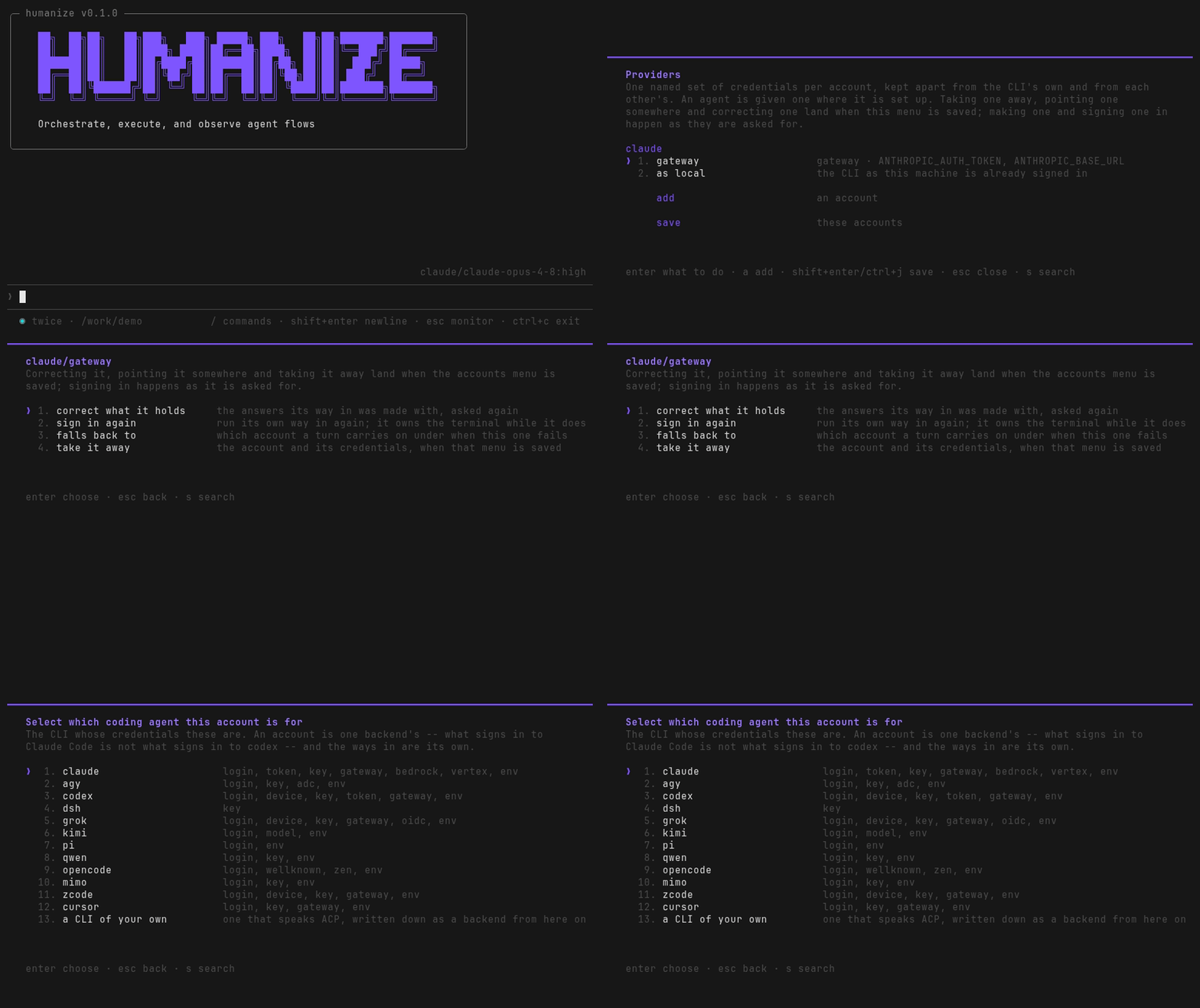
| Key | What it does |
|---|---|
| enter | Opens what there is to do with the one under the cursor: correct what it holds, sign it in again, say what it falls back to, take it away |
| a | Makes one: which CLI, then how to sign in, then what that way asks. The add row below the list does the same. The list of CLIs is also where a CLI of your own that speaks ACP is written down |
| shift+enter / ctrl+j | Saves what the menu is holding, which the save row below the list also does |
| esc | Closes the menu, asking about anything it is holding |
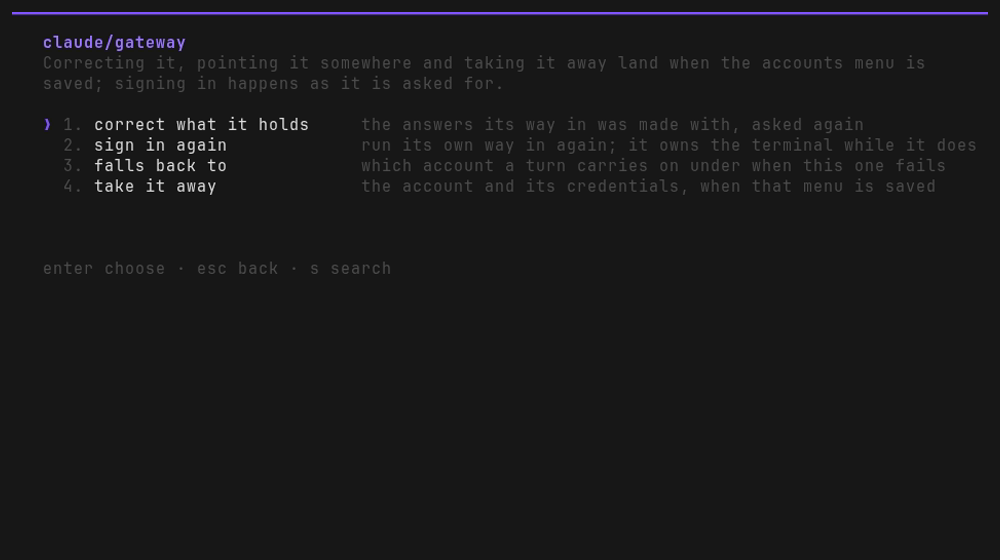
Four questions about one account are a menu rather than four letters to read off the bottom of the screen — while enter, which every list already means, was doing one of them.
Taking it away is the last of those rows, read beside what the account is and what it holds, which is what you are deciding about. It is held until the menu is saved like the rest, so an account already marked to go offers keep it after all on that same row rather than the same offer twice.
The last row under each CLI is the account this machine is already signed into — the CLI as you run it, which is what an agent nobody gave an account runs as, and where that agent's chain begins. Where it falls back to is the one of the four it takes; correcting it, signing it in and taking it away are not offered at all, and the menu says why under the row that is left: humanize did not make that account and keeps no credentials for it.
An account written down before retrying became a thing about a place still holds the tries somebody set on it, and this menu says under the list that they are no longer read: tries that have quietly stopped happening are worse than tries nobody ever set.
Taking one away, saying where it falls back to and correcting what one holds are held until the menu is saved. Making one and signing one in are not: both own the terminal while they run, and something that has already happened is not a draft.
Making one is three questions rather than one form, because each is only answerable once the one before it has been: a backend's ways in are its own, and what a way asks is the way's. A secret is drawn as bullets and never shown back — it is on its way into a credential store, which is also why correcting an account starts its secrets blank: you type one again or you leave it as it was.
A way with a login command of its own is handed the terminal: its browser or its device code owns the screen until it is done, and what it writes lands in that account's own directory rather than in the CLI's. What came of it is a line in the transcript.
Nothing here is refused while a flow is running. An agent reads the account it was configured with once, so one made or taken away now is one the next run sees.
This menu is the only way in that is typed. The same accounts are Hmz().accounts from Python, for a machine being set up without a terminal to walk.
Where a turn goes when it cannot be taken
/fallback is one page of steps between places. A place is a CLI, an account and a model, and it is what a turn can fail for having named — a model retired, a CLI that will not start, a rate limit on the whole account rather than one request. How hard the agent thinks and what it may reach for are what that agent is, so they are not asked here and come across a step unchanged.
a, and the add row below the list, choose the place that cannot run and then the place that takes its turns, each as three questions: the CLI, one of its accounts, one of the models it says it runs. Enter on a row asks the three things there are to say about a step — where its turns go, how many times over a failed turn is taken again first, and whether to be rid of it at all. Taking it away is the last of those rather than a key on the list: what the step says is what says whether it is wanted, so it is decided beside the two things it says.
The retry sheet answers in rungs rather than in numbers: the tries step through 0, 1, 2, 3, 5, 8, 13 and 21, and the time the retrying is given through as long as it takes, 30s, 1m, 5m, 15m and 1h, on the arrows or on space. A text box for an integer is a text box to validate.
An account falling back to another account of the same CLI is not here: that happens inside the conversation that was running, so it is a thing about the account, and it is on /providers.
Everything is held until the save row is chosen, the chord is pressed, or the menu is left and saving confirmed — as on every menu.
  Fallback

  Where a turn goes when the place taking it cannot take it at all. A place is a CLI, an
  account and a model.

  ❯ 1. claude@work/claude-opus-5   3 more tries, exponential · falls back to codex@key/gpt-5.6-sol
    2. codex@key/gpt-5.6-sol       falls back to dsh/deepseek-v4-flash

       add                         a step
       save                        these steps

  enter what happens · a add · shift+enter/ctrl+j save · esc close · s search
A place cannot fall back to itself, and a chain that comes round on itself ends at the second sight of a place. The same steps are Hmz().fallbacks from Python, and what they mean is Falling back.
What humanize remembers
/settings is two pages over ~/.humanize/settings.yaml, and they are two kinds of thing rather than two halves of one:
   Settings

   Everywhere · This directory                       tab/shift+tab switch

   ❯ 1. reports         on ↔   report what goes wrong to humanize
     2. sent            ▸      what a report carries, and what it never does

        save                   what is set here

   ←/→ or space change · shift+enter/ctrl+j save · esc close
Everywhere is what is true of this machine wherever humanize is run from: whether it reports what goes wrong, and — on enter — the list of what a report carries and what it never does, said under the rows. The row shows what is written down: an environment that is answering for this run says so under the list rather than being drawn as the setting, since a menu cannot change it.
This directory is what is remembered here: the directory itself, the flow it opens on and how many agents that flow was set up with, and a row that forgets the lot — leaving every other directory, and every setting, as it was.
The arrows and space step the row under the cursor, and nothing lands until the save row is chosen, the chord is pressed, or the menu is left and saving is confirmed.
Setting a flow up
Some flows take settings of their own — humanize1 takes twenty-three. A flow says so by declaring a model, and the sheet is that model with a cursor on it: one row per setting, its name, what it is set to, and the line the flow declared it with.
   gen-idea  ·  open the idea into a draft
     1. gen_idea                     on           open the idea into a repo-grounded draft
     2. n                            6            --n: how many directions explore the idea
   ❯ 3. idea_output                  docs/d.md▏   --output: where the draft goes

   gen-plan  ·  turn the draft into a plan
     4. gen_plan                     on           turn the draft into a plan, against review
     5. gen_plan_mode                discussion   --discussion or --direct: converge, or write it once
A setting that is written carries a caret under the cursor, where the next letter would land; one that is stepped does not, and the keys at the bottom say which it is. A blank one would otherwise read as a setting nothing can be typed into.
A flow with many settings groups them: each field says which part of the sheet it belongs under, and the sheet draws a heading above each group. The arrows walk the settings and step over the headings.
| Key | What it does |
|---|---|
| ↑ ↓ | Move between settings |
| ← → | Move the one under the cursor along: a switch flips, a choice steps, a number goes up or down by one |
| letters | Write the one under the cursor, for the ones that are written rather than stepped |
| enter | Take the lot, and hand it back to the menu holding it |
| esc | Back to the menu, changing nothing |
It opens as the flow is chosen — enter on a flow that takes settings puts it up, and answering it lands inside that flow's agents — and what it answers is held with the rest of that menu until the menu is saved: setting a flow up is a thing about the flow rather than about what runs it. A flow that takes no settings is not asked, so the walk is the same either way. There is no command for it, here or on a line: choosing the flow again is how you answer it again, and what you answered is what the next hmz in this directory opens on. A setup file is hmz exec -c <setup.yaml>, which runs the flow rather than opening on it.
Nothing in the interface knows what any of the settings mean. The types say how a value moves, and the flow's own model says which combinations it will not take — so a flow that refuses gen_idea without gen_plan refuses it here, in its own words, rather than an hour in.
What a run of it may spend
A budget row sits on the page a flow's agents are on, under them and above the row the menu is saved from. Enter on it opens the same three-column sheet the flow's own settings are asked on, over hours, tokens — millions of output tokens — and dollars. Each is 0 for no cap on that one, and whichever is reached first stops the run.
A row rather than a page of the walk, because every flow has an allowance and most runs want the one they already have: a page that had to be pressed past on the way to the agents is a question asked of somebody who has answered it. It is not among the flow's own settings, because it is a setting of the run — the flow declares at most a default and never holds itself to one — and the flow's own model would refuse the fields.
The row says what the run is held to without being opened: stops at 6h, 10M out, or nothing stops this run. An allowance nobody can see without opening something is one nobody checks.
Saving a menu whose run nothing at all will stop asks once whether that is what was meant. Three dimensions and none of them set is a run that goes until somebody notices, for whatever days of a model cost; that is a fair thing to ask for and a poor thing to arrive at by not answering three questions. A flow that said in its own file that it is meant to run unbounded — @flow(budget=Allowance()), which chat writes — is not asked.
What it remembers
Opening the interface again in the same project finds it set up the way you left it: the flow that was last run there, for each flow that workspace has run, what each of its agents was running, where its turns landed and which account it ran as — how the flow itself was set up, and what a run of it may spend.
Kept per flow — by the name humanize's own flows have, and by the path yours have, so a flow of yours cannot inherit the agents or the settings of the one it shares a name with. Per flow rather than per workspace alone, because what an agent runs is only meaningful against the flow driving it — a flow's second agent is its reviewer, and the flow before it had no second agent at all. Keyed by the name the flow calls each one, so a flow that grows an agent in the middle does not silently hand the reviewer's model to the builder. What was set up is read back through the flow's own model, so a setting the flow has since dropped or renamed is one it starts over from rather than one that quietly comes back.
It lives in ~/.humanize/settings.yaml. See CLI reference.
Colours
Drawn in your terminal's own colours, and it never asks the terminal what they are. Every surface is the terminal's background, and everything drawn is one of the sixteen colours your terminal already has a setting for, or a reversal of what is already there. A colour of its own would be a guess about the background it lands on.
NO_COLOR is honoured. TEXTUAL_THEME names one of Textual's own themes to use instead of the terminal's colours; a name no theme answers to is ignored rather than refused.
What it will not do
- Open twice.
hmzwith no command is the only way in — with or without-f,-cand-a, which say how it opens rather than opening a second one. - Run two flows at once. There are no flows to choose from in
/flowwhile one is running, and what the flow itself takes is not asked. What each agent is stays open: that is the half worth changing mid-run. - Guess at a bad line. A line it cannot carry out is shown and the interface stays up. Only
/exitcloses it, and one of its answers closes this terminal and not the run. - Ask the flow anything. What is drawn beside and under the transcript is kept from the turns going past. A flow is Python that may branch any way it likes, so that is the only place a run is ever visible.